


Revolutionizing Industry with Advanced Rotomolding Solutions
I see how advanced rotomolding solutions shape industries with better precision and efficiency. For example, new machines use robotic automation to reduce errors and speed up production. The North American market expects strong growth, especially as more companies use recycled and bio-based polymers to make products more sustainable.
Key Takeaways
- Advanced rotomolding uses automation and robotics to make production faster, more precise, and less wasteful, helping manufacturers create better products efficiently.
- New materials like bio-based polymers and recycled plastics make rotomolded products stronger, lighter, and eco-friendly, supporting sustainability goals across industries.
- Smart monitoring and energy-saving technologies reduce costs and environmental impact, making rotomolding a cost-effective and green choice for many applications.
Understanding Rotomolding
What Is Rotomolding?
When I first learned about rotomolding, I saw how it uses heat and rotation to shape plastic into hollow parts. The process starts with a mold filled with powdered plastic. The mold spins in an oven, and the powder melts and sticks to the inside. After cooling, I open the mold and remove the finished part. This method works well for making large, seamless items like tanks, playground equipment, and even car parts. I like how rotomolding creates strong products with smooth surfaces and no seams.
Why Rotomolding Matters in Modern Manufacturing
I notice that rotomolding is changing how we make things. Many industries now use this process because it can create complex shapes and precise parts. For example, the automotive industry uses lightweight Rotomolded Parts to help cars use less fuel. Companies also want to use more recyclable and biodegradable materials, and rotomolding supports these goals. The global rotomolding market reached about$5.0 billion in 2023 and could grow to $5.9 billion by 2031. In Asia Pacific, especially China, the demand is rising fast because electric vehicles use many rotomolded parts.
I find it impressive that new systems like ROTOFLEX can cut energy use by about 75% compared to older methods. They also reduce greenhouse gas emissions by 22%. The table below shows some key improvements:
| Metric / Improvement Aspect | Value / Impact |
|---|---|
| Energy consumption reduction (ROTOFLEX system) | ~75% of conventional process energy use |
| Greenhouse gas emissions reduction | 22% decrease in CO2 equivalent |
| Cycle time reduction | 22% time savings per part |
| Economic benefits (ROTOFLEX system) | Payback time less than 2 years |
These advances show why rotomolding is so important for modern manufacturing.
Rotomolding Technological Innovations
Advanced Materials and Composites
I see how new materials change the way I approach rotomolding. In the past, I used mostly standard polyethylene. Now, I can choose from a wide range of advanced polymers, composites, and even bioplastics. These materials help me make products that are lighter, stronger, and more resistant to chemicals or weather. When I use nanocomposites, I notice better durability and improved performance. I also like that bioplastics and recycled polymers support my goal of making more eco-friendly products. By mixing different materials, I can create parts with special features, such as extra insulation or added strength in certain areas. This flexibility lets me design products for many industries, from automotive to healthcare.
Automation and Robotics Integration
I have watched automation and robotics transform my Rotomolding Process. Robots now handle tasks that once took a lot of time and effort. I see several benefits:
- Robotic systems give me part-to-part repeatability with tight tolerances, which means less waste.
- I use programmable electric heating and cooling instead of hot ovens, which improves product quality and cuts environmental emissions by about 90%.
- Robots move in six axes, not just two, so I can make more complex shapes and control wall thickness better.
- My production cycles run faster, and I skip many labor-intensive steps, which boosts consistency.
- In one project, I saw a 27% faster production cycle while meeting strict quality standards by controlling wall thickness and making quick design changes.
These changes help me deliver better products in less time.
Smart Monitoring and Process Control
I rely on smart monitoring systems to keep my rotomolding process accurate. I use sensors and cameras to watch every step. For example, I once used a robotic system with vision-based algorithms and 3D cameras to find mold landmarks and extraction points. This system worked with a robot arm to handle hot, flexible plastic parts. I noticed fewer mistakes and less stress for my team. The system improved accuracy and made the process more reliable.
I also use advanced process control methods like multivariate analysis. This tool checks many variables at once, not just one. It helps me spot problems early and figure out what causes defects. In one study, this method found twice as many real process changes and fewer false alarms than older systems. With these tools, I can predict and prevent defects, which means I make better products every time.
Sustainable and Eco-Friendly Practices
I care about the environment, so I look for ways to make my rotomolding process greener. I use more bio-based and recycled polymers to meet my sustainability goals. I invest in energy-efficient machines to lower emissions and save money. I see more companies and governments pushing for eco-friendly practices, which encourages me to keep improving.
Here are some ways I make my process more sustainable:
- I use recycled materials that keep almost the same strength as new ones.
- I grind up leftover pieces and use them in non-load-bearing parts, which cuts down on waste.
- I blend recycled plastics from homes and factories into new products, keeping waste out of landfills.
- I reuse scrap from defective parts in layers that do not need to look perfect but still need to be strong.
- I use advanced sorting and cleaning to make sure recycled materials stay high quality.
| Aspect | Statistic / Insight | Environmental Impact / Validation of Sustainability Practice |
|---|---|---|
| Reprocessed PE residual strength | 91% post-impact residual strength compared to 93% for virgin PE | Demonstrates recycled materials retain near-virgin performance, supporting reuse viability |
| Use of off-cuts and scrap | Grinding remnants into fine powder for reuse in non-load-bearing sandwich layers | Reduces virgin polymer consumption and waste generation |
| Post-consumer waste recycling | Blending recycled PE from household/industrial sources into foam-core sandwich layers | Maintains structural integrity while diverting waste from landfill |
| Regrind from defective parts | Incorporation into layers with lower aesthetic requirements but maintained mechanical properties | Enables reuse of manufacturing scrap, reducing raw material demand |
| Challenges addressed | Advanced sorting, cleaning, and material characterization (e.g., X-ray tomography) | Ensures quality and contamination control, critical for sustainable recycling |
I believe these steps help me protect the planet while still making high-quality products.
Rotomolding Industry Impact and Applications
Automotive Sector Advancements
I see how rotomolding changes the way I make car parts. Polyethylene materials now hold over 60% of the market, and sales in North America are expected to reach $6.3 billion by 2034. I use rotomolding to create consoles, panels, bumpers, and mudguards. These parts are lightweight and strong. New technology lets me make complex shapes with different wall thicknesses. I can also print directly on parts and use bio-based polymers. This helps me customize products and track them better. The U.S. leads in using these lightweight, durable parts, which helps cars use less fuel.
Medical and Healthcare Solutions
I rely on rotomolding to make safe and clean medical equipment. The process gives me smooth, seamless surfaces that stop bacteria from sticking. I use materials that resist harsh cleaning chemicals. I add antimicrobial substances to lower infection risks. My products, like stretchers and wheelchairs, are light and easy to move. They meet strict safety standards. The table below shows how rotomolding improves medical devices:
| Success Metric | Impact |
|---|---|
| Chemical Resistance | Equipment lasts longer and stays safe |
| Surface Quality | Smooth surfaces make cleaning easy and prevent germs |
| Durability | Products handle heavy use without breaking |
| Antimicrobial Additives | Lower infection risk for patients and staff |
| Design Flexibility | Custom shapes improve comfort and care |
Construction and Infrastructure Developments
I use rotomolding to make products for building and infrastructure. These include traffic barriers, storage containers, and water tanks. My products last a long time and resist weather. I see more cities using rotomolded items because they are easy to move and cost less than metal. I also use recycled plastics to help the environment. New projects, like smart city upgrades and renewable energy, increase demand for these products.
- I make marine buoys with rotomolded parts that last longer and need less care.
- My rotomolded boats stay safe and float even if they flip over.
- I produce sinks, bathtubs, and insulation blocks that meet tough standards.
Consumer Products and Packaging
I notice more companies use rotomolding for packaging and everyday products. I make water tanks, barricades, and traffic cones that are light and do not rust. New printing and labeling methods, like RFID smart labels, help me add branding and track products. I use bio-based polymers to make packaging eco-friendly. The global market for these products reached $8.5 billion in 2023 and keeps growing. I see more demand for recyclable, customizable containers that meet new sustainability goals.
Overcoming Rotomolding Challenges with Innovation
Addressing Design Complexity
When I design new products, I often face complex shapes and performance needs. I use fiber surface treatments to make my parts stronger and stiffer. These treatments help me create products that can handle more stress and last longer. Here are some ways I measure these improvements:
- Tensile modulus goes up by 56% with treated fibers, so my parts become much stiffer.
- Flexural modulus increases by 60%, which means my products bend less under pressure.
- Impact strength improves by 19%, making my parts tougher and less likely to break.
These numbers show me that my strategies work well for handling complex designs.
Enhancing Production Scalability
I want to make more products without losing quality. I use smart control systems and automated thermal controls to help me scale up. These tools let me make more parts in less time and with better accuracy. The table below shows how these innovations help me:
| Innovation Aspect | Production Volume / Efficiency Impact |
|---|---|
| SmartFlow Control System | Cycle time reduced by ~20%, leading to 16% more production without extra shifts |
| Automated thermal control & ML | Dimensional precision improved by 15% |
| Energy consumption per cycle | Reduced by 28%, lowering costs and supporting scalability |
I also see strong market growth, which tells me that these changes matter.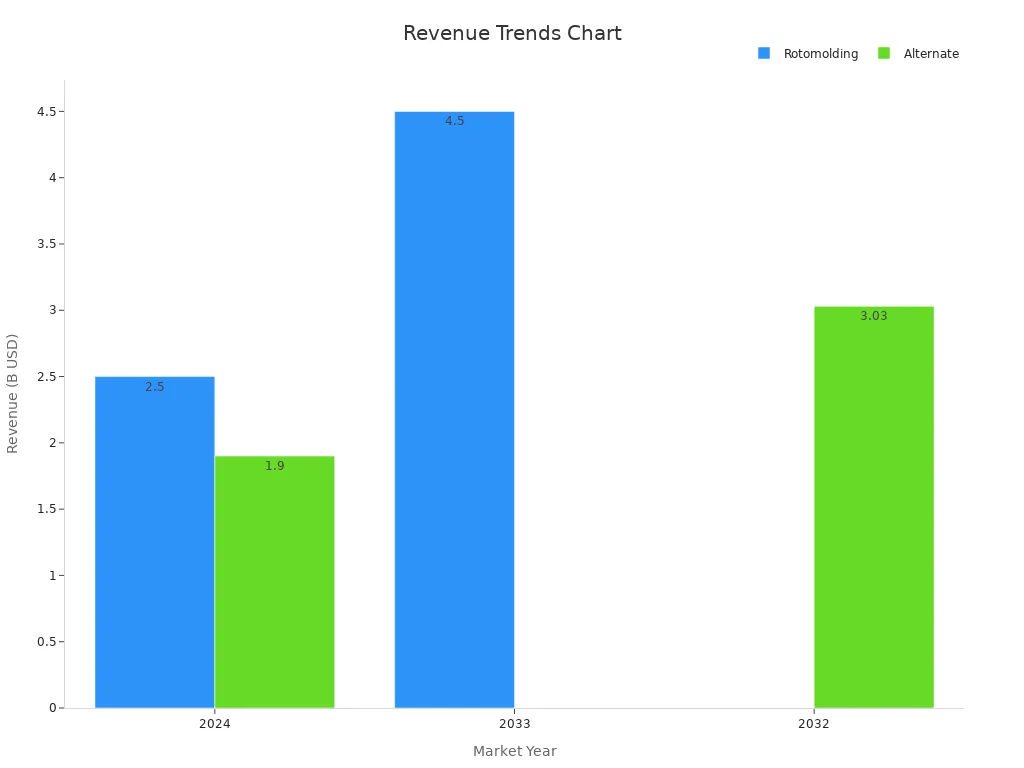
Improving Cost Efficiency
I always look for ways to save money and work smarter. I notice that my process uses fewer steps than metal or fiberglass methods, so I spend less on labor and equipment. My plastic materials cost less than metals. Because my parts are lighter, I pay less for shipping. I also get more design freedom, which helps me avoid extra costs from complicated shapes. My parts resist rust, so I do not need to spend much on repairs. Here are some benefits I see:
- Fewer manufacturing steps lower labor and equipment costs.
- Plastic materials cost less than metals and fiberglass.
- Lightweight parts reduce transportation expenses.
- Design flexibility cuts down on complexity and costs.
- Corrosion resistance means less money spent on maintenance.
These changes help me keep my business strong and competitive.
Future Trends in Rotomolding
Digitalization and Industry 4.0
I see digitalization changing how I work with rotomolding every day. Industry 4.0 brings smart technology into my factory. Now, I can connect machines, robots, and computers to one network. This helps me track every step of production. I use sensors and digital tags, like NFC chips, to store information right on each product. My machines talk to a central computer, so I can control the process from one place. Here are some ways Industry 4.0 shapes my work:
- I can make custom products with digital information built in.
- My machines and robots work together in smart cells.
- I collect and store data for full traceability.
- I use software to plan and monitor production.
- Standardized interfaces help my machines share data easily.
I notice that Asia-Pacific leads with smart factories and AI, while North America focuses on research and automation.
Expanding Material Capabilities
I watch new materials change what I can do with rotomolding. I use more bio-based polymers made from plants and algae. These materials give my products better strength and flexibility. The market for bio-based polymers grows fast, with an 18% yearly increase expected from 2024 to 2029. I see more companies investing in these materials because they want eco-friendly products. I also use new techniques to make my products last longer and work in new areas like renewable energy and medical devices. Even though I cannot use metals or ceramics, I keep finding ways to improve with polymers.
- Bio-based polymers come from renewable resources.
- They offer better wear resistance and flexibility.
- Research helps me expand into new industries.
Global Market Growth
I see the rotomolding market growing around the world. More companies use bio-based polymers, and new rules support biodegradable plastics. The automotive industry wants lighter parts, and Asia-Pacific builds more factories. North America and Europe also invest in new technology and research. The global market could grow from $5.66 billion in 2024 to $12.68 billion by 2037, with a 6.4% yearly growth rate. I notice more demand in packaging, agriculture, and construction. Even with some challenges, I feel excited about the future because new applications and better technology keep the market strong.
I see rotomolding change every year.
- Automation and robotics make my work faster and more precise.
- New materials and coatings help me create stronger, longer-lasting products.
- I use recycled plastics to protect the environment.
- Smart sensors and software improve quality and speed.
I believe these advances will keep opening new doors in manufacturing.
FAQ
What products can I make with rotomolding?
I can make water tanks, playground slides, car parts, and medical equipment. I also create packaging, traffic barriers, and custom containers. Rotomolding works well for large, hollow items.
How does rotomolding help the environment?
I use recycled and bio-based plastics. My process creates less waste and uses less energy. I reuse scrap materials. These steps help me lower my environmental impact.
Is rotomolding cost-effective for small batches?
I find rotomolding ideal for small runs. I do not need expensive molds. I can change designs quickly. My setup costs stay low, so I save money on short production runs.